Family Background and Life Turning Points
Chi Wen-Hao was born into a wealthy and stable family. During his childhood, he lived in comfort: household help was available, relatives and friends visited often, and praise and affirmation were part of everyday life. Growing up in such an environment, wealth was not a ‘goal to pursue’ but an unquestioned part of daily life. It shaped his early view of the world: life seemed naturally stable and smooth.
However, this perception was completely shattered when he was twelve years old.
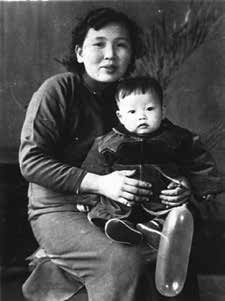
Chi Wen-Hao's childhood photo with his nanny, Qiu Jinyuan
In 1960, when he was forty-four, his father suffered a sudden stroke and collapsed. Within a short period, the originally large-scale enterprise rapidly disintegrated, and the family's economic foundation and social status collapsed simultaneously. For twelve-year-old Chi Wen-Hao, it was a violent rupture—an abrupt fall from security into uncertainty, from the familiar into the unknown. The family structure changed, the lifestyle was reversed, and the sense of security disappeared overnight.
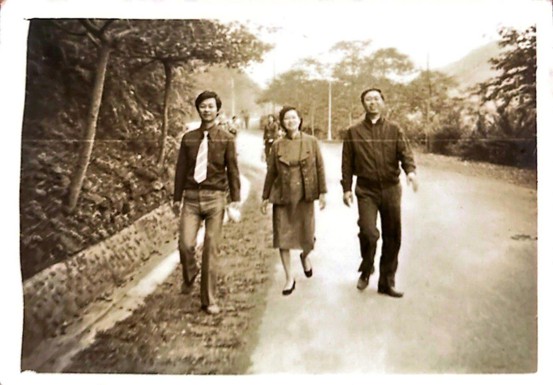
After starting his business, Chi Wen-Hao rarely went on outings with his family; on holidays, he was often still dressed formally. From left to right: Chi Wen-Hao, his mother, and his eldest brother
Family Support
This change forced him to realize one thing early on: the world will not guarantee that you can continue to have something in the future just because you once had it.
After the family’s downturn, Chi Wen-Hao began to feel a profound gap between himself and the world around him. The past enthusiasm and closeness were gradually replaced by alienation and reality; schooling, life, and future directions were all shrouded in uncertainty.The family no longer had resources or protection to rely on, and every choice had to be made with practical constraints in mind.
Despite successfully passing the Taipei Joint Entrance Exam and getting into Taipei Municipal Song Shan Senior High School of Commerce, he couldn't afford the tuition due to his family's financial situation. This path, once seen as a way to secure a foothold, ultimately could not be continued. This wasn't due to a lack of ability, but rather the limitations of reality, where hard work doesn't always immediately pay off.
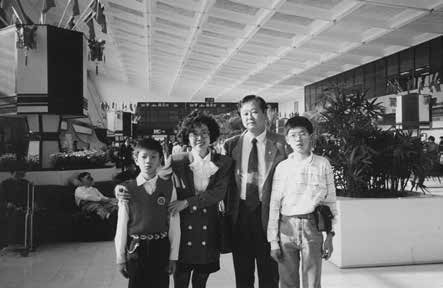
Before traveling to the United States for business and before the eldest son, Cheng-Wei, left to study in Australia, the family of four took a photo at the airport. From left to right: the second son, his wife, Chi Wen-Hao, and the eldest son.
Finally, with the help of his aunt, he entered Tamkang High School. This choice was not a fallback, but an opportunity to regain his footing in reality, and it became another important starting line in his life.
To stay in school, working while studying was no longer a choice—it was the only way forward. For most peers, the student period is still a stage of being cared for and arranged; but for Chi Wen-Hao, those years meant being both a student and a breadwinner for the family.
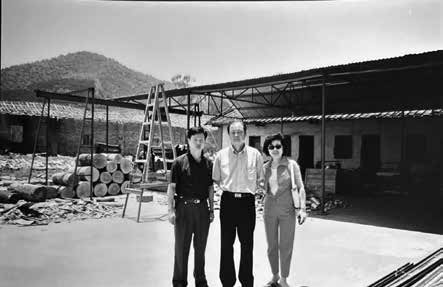
Chi Wen-Hao and his wife, Liu Gan-Gan, went to mainland China and took a group photo with the purchasing representative outside the Nan Jing factory in Fujian. From left to right in the picture: purchasing representative, Chi Wen-Hao, wife Liu Gan-Gan
During the most difficult period for the family, his aunt and uncle, Lei Mao-Lin, became important pillars for him. His aunt introduced him to a job as a caddie at the old Tamsui golf course, where he could earn 50 yuan a day, which roughly equivalent to about two thousand yuan in today’s value. This job not only provided practical support for his school life, but also symbolized something essential: in adversity, someone may reach out a hand, but you still have to stand up on your own.
This experience made Chi Wen-Hao understand the meaning of responsibility, labor and independence earlier than his peers, and also laid the foundation for his character of not easily retreating when facing risks in the future.
The Strength of Marriage
After entering society and trying to start a business, Chi Wen-Hao's life did not immediately become stable. In the stage where his career had not yet taken shape and the future was full of uncertainty, his wife, Liu Gan-Gan, always accompanied him. Facing the difficulties and multiple crises in the early stages of entrepreneurship, she did not complain or waver, but chose to fully support his decision and become his most steadfast and reliable support.
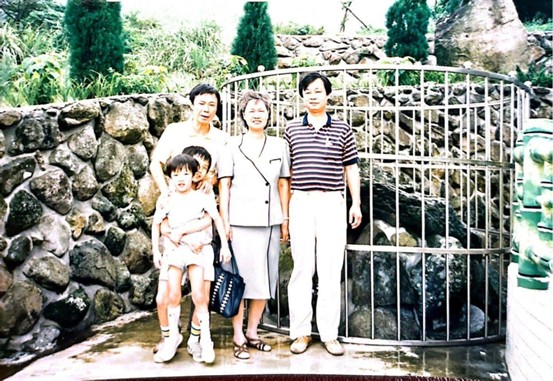
Photos of outings with family
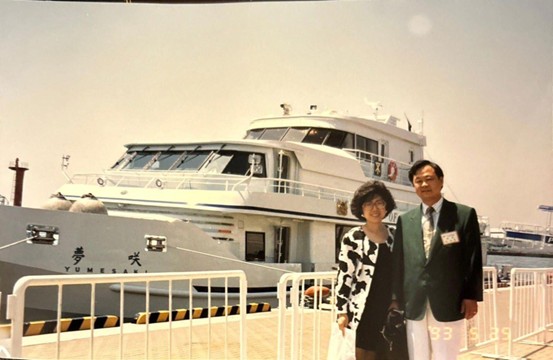
In 1993, Chi Wen-Hao and his wife led the Southwest Lions Club to visit the sister club of the Osaka Lions Club in Japan. They were treated to a ferry trip around the Kansai Port as shown in the picture.
Chi Wen-Hao is also deeply grateful for the perseverance inherited from his parents. For him, family is not just an emotional support, but a source of strength that gives people the courage to take risks and make long-term investment decisions. It is in a relationship of being understood and trusted that he has been able to get through the troughs time and time again.
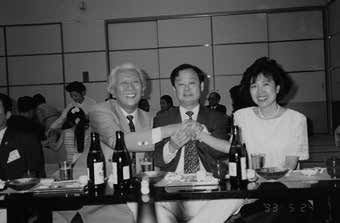
Pictured with Hiroshi Nishikawa, a member of the Lions Club of Osaka Port, Japan. From left to right: Hiroshi Nishikawa, Chi Wen-Hao, and his wife.